A bullet journal habit tracker is a hand-drawn page where each habit gets a row and each day gets a box you fill in. The monthly grid is the classic version. A weekly row, a single streak line or an extra energy row work just as well. Three to five habits is plenty.
You know the pretty spreads online. Brush lettering, washi tape, a different theme every month. They look great on the first of the month. By the 12th, half the boxes are empty and the page feels like a small accusation.
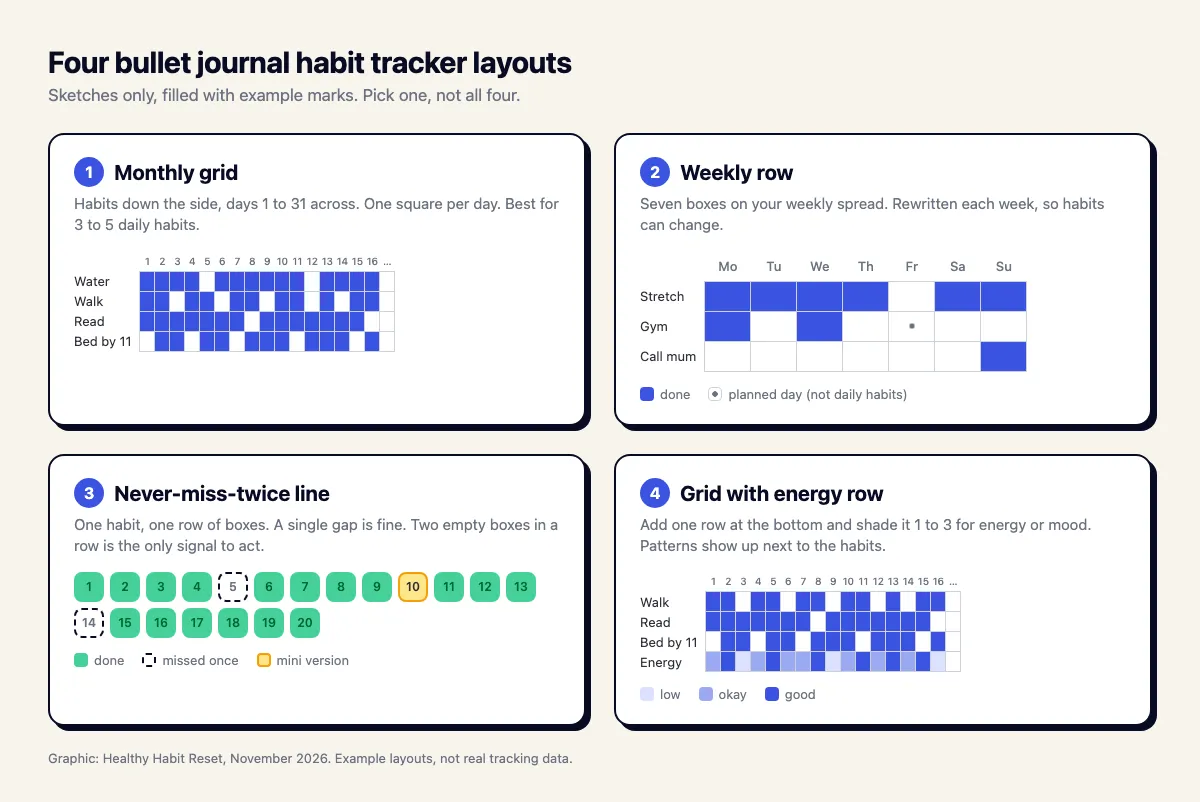
The layout that lasts is usually the plain one. Here are four that are quick to draw, with a sketch of each.
Which layout fits your week?
The monthly grid. Habits go down the left edge, the days of the month across the top. Fill a square when you did the thing. A bulletjournal.com roundup features it as a minimal tracker added to the Monthly Log, a page of the method created by Ryder Carroll. It works best for daily habits that stay the same all month.
The weekly row. Seven boxes per habit, drawn on your weekly spread and redrawn every Monday, which sounds like extra work until you notice that the redrawing is what keeps the list honest. If a habit no longer fits, you just leave it off next week. For habits that only happen on some days, put a small dot in the box on planned days. The same roundup suggests exactly that.
The never-miss-twice line. One habit, one long row of boxes, nothing else. A single empty box is allowed. Two empty boxes next to each other are your only warning sign. This suits the one habit you care about most right now.
The grid with an energy row. Take the monthly grid and add one more row at the bottom. Shade it light, medium or dark for how your energy or mood felt that day. After a few weeks you can see whether the short walks line up with the better days. That's no proof of anything, of course, though seeing it on paper is often motivating.
What does a 10-minute setup look like?
You need: your notebook, one pen, a ruler if you like straight lines. That's it. Colored pens are optional and can wait.
Start by choosing the habits before you touch the page. Write them on a scrap of paper first and cross out anything vague. "Exercise" becomes "10-minute walk". "Read more" becomes "one page before bed". If a habit can't be ticked as yes or no, you'll hesitate every evening and the box stays empty.
Then count your grid. For a monthly layout, mark one column per day and one row per habit, plus a column for the habit names on the left. Squared or dotted paper makes this fast because the boxes are already there. Draw the outline in pen, label the days with small numbers and write the habit names last.
Leave the decoration for later. If you're still filling in the tracker after two weeks, then it's earned a doodle in the corner.
Finally, put the page where you'll see it. A habit tracker hidden 40 pages deep in the notebook gets forgotten. Clip a bookmark, a paperclip or a sticky tab to it so it opens at the right place.
How many habits fit on one page?
A full spread has room for a long list. In practice, three to five is a better starting point.
Every habit is one more thing to remember in the evening, and ten rows quietly turn the tracker into a report card that nobody enjoys opening. Three rows take ten seconds.
Make each habit small enough that you'd do it on a bad day too. The 2-minute rule is a good filter here: if the habit takes longer than two minutes to start, shrink it until it doesn't.
You can always add a fourth row next month. Adding is easy on paper. Crossing out a habit you gave up on halfway through feels worse.
What should you mark on a bad day?
Some days the box stays empty. That's normal and it isn't the end of anything.
In a well-known study by Phillippa Lally and colleagues, missing one opportunity did not materially affect the habit formation process. The same study found it took participants anywhere from 18 to 254 days to get close to full automaticity. So a single gap matters far less than it feels in the moment. Keep going.
Two tricks help on paper. Draw a smaller mark, a half-filled box or a dot, for the mini version of the habit: one push-up instead of twenty, one page instead of a chapter. It still counts, and the row stays connected. Kara of Boho Berry, quoted in the bulletjournal.com roundup, also suggests reading the grid as "when was the last time I did this" rather than as a daily test. That takes a lot of pressure off.
If you like the chain idea, the don't break the chain method explains why a row of filled boxes pulls you forward, and what happens when it breaks.
When does paper stop working?
Paper is great at being visible and calm. No notifications, no other apps one swipe away. It also has limits, and they tend to show up after a month or two.
You leave the notebook at home and three days go unrecorded. You want to see how this October compared to last October, and that means flipping back through pages and counting. You want a nudge at 9 pm, and paper can't give you one. Or you want a friend to see your progress and keep you honest, and showing them a notebook every week is a bit awkward.
None of that means paper failed. It means the job changed.
Paper or app: which one suits you?
| | Paper bullet journal | Habit app | |---|---|---| | Setup | Draw it yourself, 10 minutes a month | Install, add habits, done | | Flexibility | Any layout, any symbol, any time | Limited to what the app offers | | Reminders | Only if you open the notebook | Push notifications | | Away from home | Only if you carry the notebook | On your phone | | Looking back | Flip pages and count | Charts and streaks, depending on the app | | Sharing | Show someone the page | Some apps let friends follow along | | Screen time | None | Lives on the same phone as everything else | | Cost | Notebook and pen | Free tiers, subscriptions or one-time purchases vary |
Plenty of people use both: paper for the reflective part, an app for reminders. If you lean toward an app, our comparison of the best habit tracker apps goes through the main types and their free versions.
Start with one page
Open your notebook to the next empty spread. Pick three habits, draw the grid, write today's number at the top. Fill in tonight's boxes before you close it.
If you get a few weeks in and find you'd rather have the plan handed to you, with a fixed list of daily tasks, Healthy Habit Reset is built around challenges like that. If the notebook keeps working, stay with the notebook. Either one is fine as long as you still open it next month.